The call of the Leopard frog marks the second wave of our local frog and toads breeding season. Spring Peepers, Wood frogs and Western Chorus are the first out, followed by the Leopard frog, American toad and Pickerel frog. This second wave does not have the same freeze tolerance of the first wave, even though they do begin migrating at the same time. Their defense against freezing is to either burrow below the frost line or submerge themselves in a body of water. Even though we have wildly fluctuating temperatures, we will not have a dip so drastic as to freeze a pond with several inches of ice.
Leopard frogs can be identified by their rounded, irregular rows of dark spots, strong dorsal lateral folds, banded legs and a pointed snout. Base color and spot patterns vary greatly among individuals. Some may have a bronze base color with large spots, some may have a brilliant green with small spots. Their call sounds like a descending snore followed by several soft grunts. A strong chorus will often have more of the grunting sounds as males work out their territory through posturing and positioning.


Leopard frogs are often confused with Pickerel frogs as both are spotted. The main difference is that Pickerel frogs have more squared off spots in parallel rows and Leopards are more rounded and random.
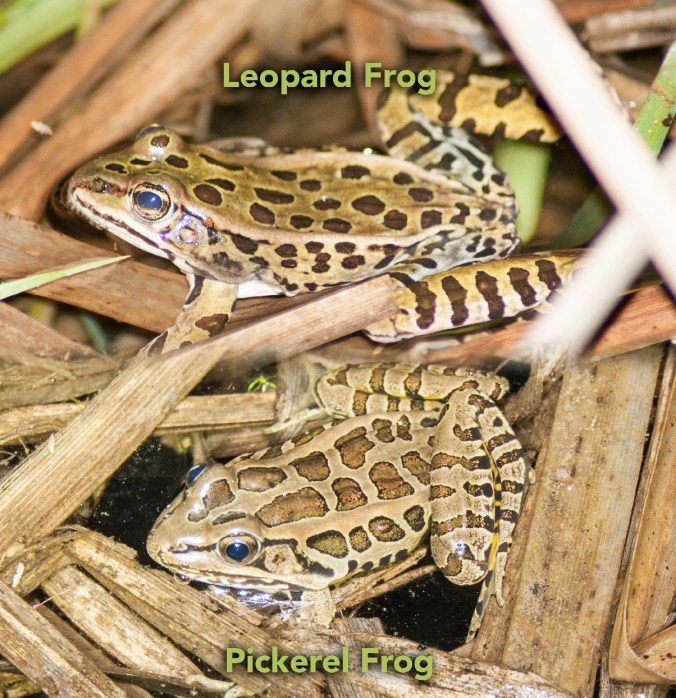
A comparison between a Leopard frog (top) and Pickerel frog (bottom)
 Ohio Frog Blog